
Outsourced Menu Nutrition Analysis: Services, Deliverables, Timelines, and Costs
Outsourced menu nutrition analysis means bringing in a specialist team, usually led by registered dietitians, to build, check, and maintain the recipe, nutrition, and allergen data behind your menus. A good partner works inside the menu management system you already use, tells you in writing what you will get, and keeps the data current after the first project ends. This guide covers the services, deliverables, timelines, and cost model to expect.
What Is Outsourced Menu Nutrition Analysis?
Every calorie count, allergen icon, and ingredient list a guest sees starts as data in a recipe database. Outsourced menu nutrition analysis is the work of getting that data right when your own team does not have the hours or the specialist skills. It is menu data work, not clinical dietitian staffing. The people doing it spend their time in recipes, ingredients, and system settings rather than with patients or students.
Why Do Foodservice Teams Outsource It?
Most dining programs have thousands of recipes and a small number of people who can maintain them. Ingredients get swapped, suppliers reformulate products, and new recipes are added in a hurry. Over time, the data drifts away from what is on the plate. The gaps show up in front of guests, on online menus, screens, and labels.
Teams usually look for help at one of three moments: they are moving to a new menu management system, they have lost dietitian capacity, or they have found errors and no longer trust what they are publishing. We covered why accuracy has to hold up in public in why ADA compliant online menus must stay accurate.
What Services Should a Menu Nutrition Analysis Partner Offer?
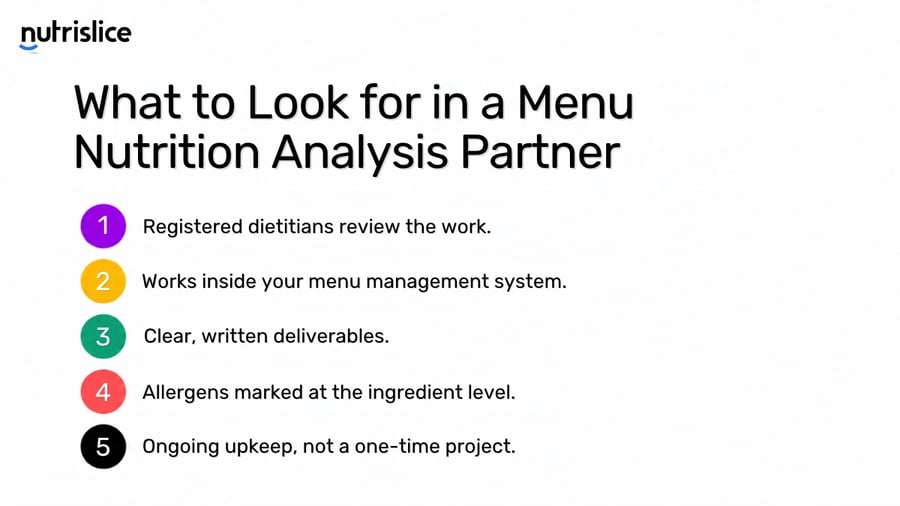
1. Recipe Data Builds and Nutrition Analysis
The core service is building recipes in your system with the right ingredients, yields, and portions so that nutrition values calculate correctly. Ask who does the work and who reviews it. Registered dietitians should check the result.
2. Data Cleanup and Conversion in Your System
If you already have a recipe database, the job is often cleanup: fixing duplicates, broken ingredient links, and missing data, or converting it for a new system. The partner should work inside the system you use. The DataTrust team works in Illumia (formerly CBORD), JAMIX, Galley, Agilysys-Eatec, and others.
3. Allergen Marking at the Ingredient Level
Allergens should be marked on ingredients and rolled up to recipes, so one supplier change updates every dish that uses it. Ask which allergens are covered. The nine major allergens plus gluten is a common standard.
4. Menu Labeling and Nutrition Facts Support
If you post calories or sell packaged grab-and-go items, you may need help with FDA menu labeling and Nutrition Facts labels. The same clean data then feeds digital food labels at the station. See how digital food labels work.
5. Audits and Ongoing Upkeep
A one-time project will drift again. Look for audits, such as a review of a campus food allergy program, and for ongoing monitoring that catches new gaps as menus change.

What Deliverables Should You Expect?
Ask for deliverables in writing before work starts. A typical set includes:
- Recipes built or corrected in your system, with nutrition values that calculate.
- A verified ingredient database with allergens marked.
- Written allergen protocols your team can follow after the project.
- A record of what was reviewed and changed.
Public examples from DataTrust show the scale involved. For Appalachian State, the team "Built 1,500+ recipes, a verified ingredient database, and established allergen protocols from scratch." For Kent State, it "Updated 2,600 recipes in a high-speed audit, then provided interim RD coverage." UC Berkeley's project involved building 3,000+ custom recipes in two phases.
How Long Does an Engagement Take?
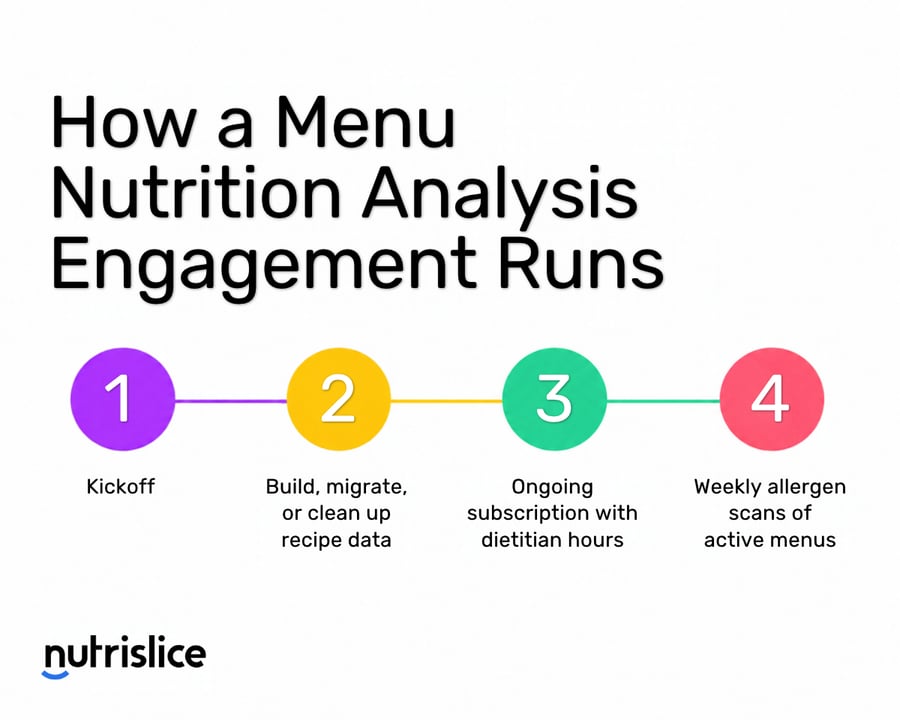
Timelines depend on how many recipes you have and what shape they are in, so be wary of a fixed promise made before anyone has looked at your data. The usual shape has two parts. Most DataTrust engagements begin with a kickoff, a focused surge of services to build, migrate, or clean up recipe data, on top of an ongoing subscription. Large builds are often split into phases. After the kickoff, the work shifts to upkeep, and Allergen Intelligence scans active menus weekly.
What Does Outsourced Menu Nutrition Analysis Cost?
Cost comes down to scope: the number of recipes, the condition of the data, the system it lives in, and how much dietitian time you want each month. Expect two parts to a quote, a one-time kickoff and a monthly subscription. DataTrust subscriptions are sized by fractional dietitian time, with a Basic tier of up to 16 hours a month and an Advanced tier of up to 32 hours a month. DataTrust does not publish dollar prices, so ask for a quote based on your recipe count and goals.
When you compare quotes, compare what is included. The cheaper path of importing old data and fixing it later tends to cost more in the end. As one DataTrust customer put it, "Without them, we would have just imported old data and hoped to clean it up later."
How Do the Common Approaches Compare?
- Doing it in-house. Keeps knowledge close, but competes with every other job your dietitian and managers have.
- Clinical dietitian staffing. Adds a credentialed person, but the role is usually built around clinical care, not recipe databases.
- Software alone. Finds problems quickly, but someone qualified still has to decide what is correct.
- A dietitian-led menu data service. Combines tools that find gaps with registered dietitians who fix them, inside your system.
Why Do Foodservice Teams Choose Nutrislice DataTrust?
Nutrislice DataTrust pairs Nutrislice AI with credentialed dietitians. It comes from the Menu Analytics team, which joined Nutrislice in 2026, and offers RD Data Services, Allergen Intelligence, and Recipe Intelligence. The team is led by Lisa Eberhart, RD, LDN, who has 20+ years in nutrition analysis, and Randy Lait, who spent 36 years leading NC State Dining.
DataTrust works in the menu management system you already have. Nutrislice does not do menu management and does not replace that system. Once the data is right, the Nutrislice platform publishes it to menus, signage, and labels. Our buyer's guide to digital menu software and campus dining menu software guide cover that side, and cycle menu software explains how repeating menus fit in.
FAQ: Outsourced Menu Nutrition Analysis
What is outsourced menu nutrition analysis?
Outsourced menu nutrition analysis is a service in which a specialist team, led by registered dietitians, builds, checks, and maintains the recipe, nutrition, and allergen data behind a foodservice menu.
Do we need to change our menu management system?
No. DataTrust works inside the system you already use, including Illumia (formerly CBORD), JAMIX, and Galley.
How much does it cost?
It depends on your recipe count and the condition of your data. Expect a one-time kickoff plus a monthly subscription sized by dietitian hours. Ask for a quote based on your scope.
Is this the same as hiring a clinical dietitian?
No. This is menu data work: recipes, ingredients, nutrition values, and allergens in your system. It supports your dietitian rather than replacing clinical care.
Bottom Line: Get the Data Right, Then Keep It Right
Outsourced menu nutrition analysis works best when the partner is dietitian-led, works in your system, puts deliverables in writing, and stays on to keep the data current. To talk through your recipe database and what a kickoff would involve, talk to the DataTrust team.